
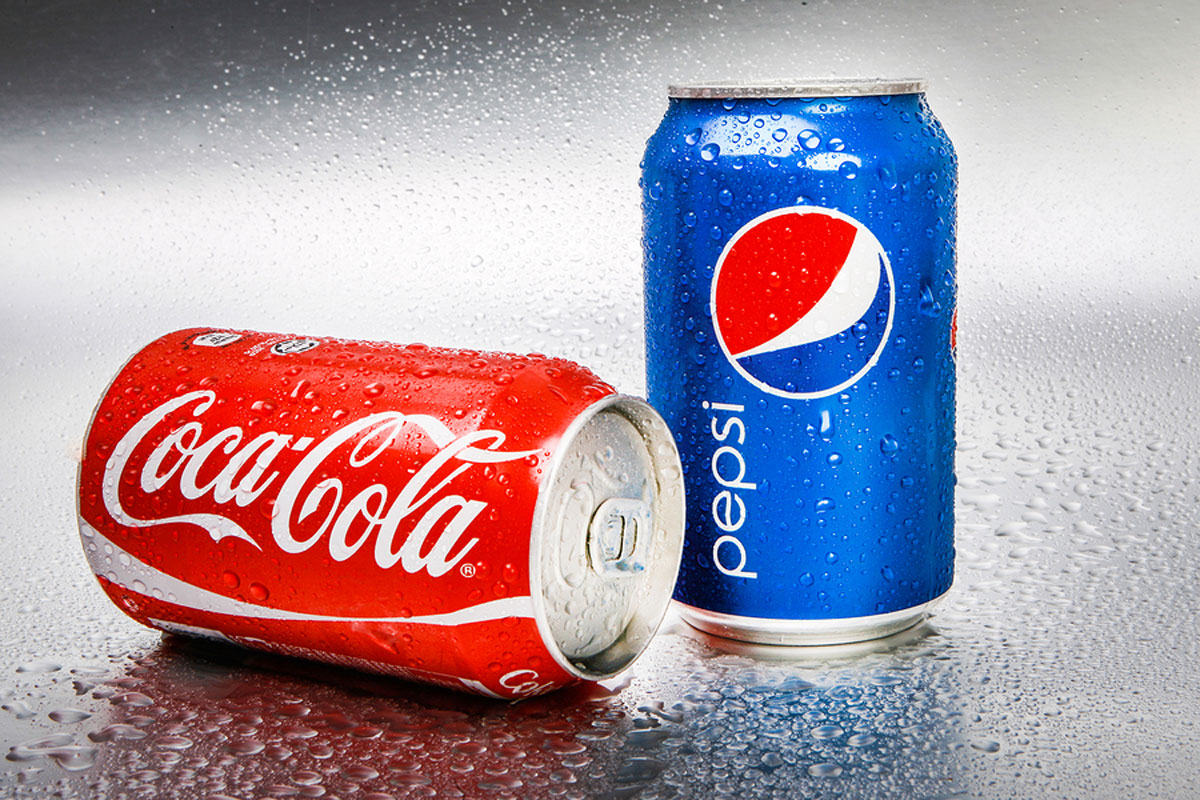
What is the difference between Coca-Cola and Pepsi
Today, Pepsi-Cola and Coca-Cola occupy a unique, historically established niche in the world of soft drinks. In their attempt to win over consumers, the companies behind these beverages have been waging advertising wars for as long as anyone can remember. They compete over everything: whose taste is better, whose product line is broader, whose can looks cooler, whose advertising is more expensive, and whose campaigns feel more emotional. And, of course, over sales volumes as well.
Failures on this century-old battlefield cost managers their jobs. New generals arrive with new plans and rush into battle. Meanwhile, we watch this rivalry from the most important seat of all. Both iconic drinks stand side by side on supermarket shelves, and the direction in which consumers most often reach determines where both companies will go next.
Consumers themselves are part of these battles, dividing into two opposing camps and actively pushing their favourite brands in the direction they prefer. Did you know, for example, that several hundred thousand Americans took Coca-Cola to court in an effort to force the company to bring back its old formula? Or that Pepsi’s larger bottles are a tribute to its historic success during the Great Depression?
The Theory and...
The battle between Coca-Cola and Pepsi began in 1898. That was the year, 12 years after Coca-Cola first appeared, when New Bern pharmacist Caleb Bradham sold his first Brad’s Drink, which would later be renamed Pepsi-Cola.
Pepsi’s first bold move in this battle came in the late 1930s. During the Great Depression, Pepsi was sold in 340 ml bottles, while Coca-Cola came in 170 ml bottles. The price, however, remained the same: five cents per bottle. This ruthless price challenge was accompanied by an unforgettable advertising jingle with the message: “Pepsi-Cola hits the spot, twelve full ounces, that’s a lot! Twice as much for a nickel, too! Pepsi-Cola is the drink for you.”
From 1936 to 1938, Pepsi doubled its sales, thanks in no small part to the Great Depression. And that slogan continued to live in the minds of American consumers for another twenty years. In a way, Pepsi still follows the same “more for the same price” strategy decades later. For example, in Russia, Coca-Cola was sold in 0.5-litre bottles, while Pepsi was offered in 0.6-litre bottles.
The marketing war reached its peak in the 1980s, when Pepsi came as close as ever to its principal rival. Blind taste tests at the time showed that consumers preferred Pepsi when they sampled both drinks from ordinary glasses without seeing the labels.
Historically, Coca-Cola appeared before Pepsi. Yet both drinks were invented by pharmacists as stimulating, mood-lifting remedies that were even believed to improve digestion. Incidentally, both pharmacy-born formulas were patented.
At the beginning of their long journey, the two colas differed quite dramatically. Coca-Cola contained cocaine from coca leaves - the favoured narcotic of Bolivian Indigenous peoples - and caffeine from the kola nut. Pepsi-Cola, meanwhile, was made using pepsin and caffeine from kola nuts. The objective boundaries between the two drinks began to blur in 1903, when cocaine was prohibited from use in the production of Coca-Cola.
From there, the story only became more complicated. The composition of both colas changed repeatedly. Roughly 70 years after Coca-Cola first appeared, caffeine was removed from its formula as a tranquillizing agent. “Tranquillizing? But what about coffee?” you may ask. The answer is simple: the amount of caffeine in coffee is far smaller than many people imagine. There is even less of it than in green tea. Colas also contain a certain percentage of caffeine, but it has been reduced so much that it is unlikely to energize even a well-rested person.
In the spring of 1985, a suddenly anxious Coca-Cola made a move that cost almost the entire top management team their positions: it changed the classic formula and released New Coke, a sweeter drink with more pronounced vanilla and orange notes - in other words, a product brought as close as possible to its competitor. The blind test results were highly encouraging: people chose the new cola. But life, including this very example, has long proved that marketing research and real life often have very little in common. A public scandal erupted. Fans of classic Coca-Cola organized and demanded that the company stop trampling on consumers’ feelings and return everything to the way it had been. The organization of old-cola loyalists was not some modern social-media group; it quickly gathered several hundred thousand members and took the manufacturer to court. Against pressure of that scale, no sensible company has a real defence. Less than six months later, Coca-Cola Classic appeared in stores. After some time, the word Classic disappeared from cans and bottles, because New Coke was discontinued completely and there was no longer any need to distinguish between the two drinks.
Every cloud has a silver lining: the campaign to defend the old cola led to a sharp jump in sales of the original soda. This was of little comfort, however, to the initiative-driven top management team of 1985 - almost all of them were dismissed, having triggered such a serious scandal. Pepsi once again found itself in the role of the challenger trying to catch up. Realizing that things were going even worse than they had been for Coca-Cola before the formula scandal, Pepsi launched another rebranding in 1991. The drink’s name was moved outside the circle, given a fashionable slant, and a red diagonal panel was attached to the circle. As for the company’s appreciation for classic taste, it seems Pepsi remembered the lesson, although it placed it on the farthest shelf for the time being. Twenty-four years after Coca-Cola’s “day of marketing shame,” Pepsi launched Pepsi Throwback in the United States for eight weeks - a soda made according to a 1970s-style recipe. Demand proved so encouraging that the company announced it would keep selling the classic Pepsi as long as people continued to buy it. The drink’s recipe includes sugar, highlighted by the label inscription Made with Real Sugar. According to the company, 50% of purchases came from consumers belonging to Generations X and Y.
Let us return to the 1990s. Work on a large-scale global transformation of the brand began in 1992. The objectives were defined quickly. The main demand placed on the designers was to make Pepsi as instantly recognizable around the world as Coke’s standard red cans and bottles. The project also had to move as far away as possible from Pepsi’s familiar advertising style, especially since the company had suffered a major blow at the time: Michael Jackson, the central figure in its advertising, had been accused of child molestation, and PepsiCo had to urgently distance itself from him.
The company reviewed more than three thousand concepts. The winner was Project Blue by Landor Associates. Of PepsiCo’s three main colours - blue, white, and red - it left only one dominant colour. Everything connected with the brand, from cans and bottles to company vans and store refrigerators, was to become unmistakably blue. A new Pepsi slogan was also approved. “The Choice of a New Generation,” which had lasted for more than ten years, was replaced by “Pepsi Changes the Script.” Yet the company was slow to change the script. While Pepsi was secretly developing its new image, its competitor was widening the gap. In 1995, for every bottle of Pepsi sold worldwide, three bottles of Coke were sold.
The beginning of 1996 was the last moment when PepsiCo still had a chance to capture the world’s attention. The Olympic Games were scheduled for the summer of 1996. This time the Olympic capital was Atlanta - Coca-Cola’s hometown - and it was no secret that PepsiCo’s competitors intended to use the event to maximum advantage. Pepsi decided to overshadow Coca-Cola’s Olympics with a global tour of PepsiCo advertising stars through world capitals, with Moscow included on the list.
On April 2, 1996, a Concorde specially repainted for the occasion in dazzling blue landed in London. PepsiCo executives stepped out of the aircraft alongside Pepsi advertising stars Cindy Crawford, Andre Agassi, and Claudia Schiffer, announcing the beginning of a new era: Blue Pepsi.
As always happens at events of this scale, there were a few curious incidents. For example, repainting the supersonic Concorde, which cost the company about $190,000, noticeably reduced the aircraft’s speed. Pepsi’s space advertising also passed almost unnoticed. The new Pepsi was promoted by Russian cosmonauts in orbit, giving PepsiCo representatives a formal reason to claim that the company controlled 100% of sales in space. But when the promised live link with the Mir space station finally took place, the cosmonauts, standing in front of a Pepsi poster, delivered the company’s advertising slogan and, apologizing for the lack of time, disconnected.
Today, both drinks consist primarily of sugar and water. They also contain various acids, including citric acid. It irritates the stomach lining and creates a false sensation that the body lacks water - in plain terms, thirst. At this point it is worth debunking the myth that a piece of meat can dissolve in a glass of cola. In reality, a piece of meat can dissolve in any liquid that contains citric acid. Yet we still eat oranges, and they can be beneficial for the body.
Like all carbonated soft drinks, colas contain colourants, acidity regulators, preservatives, and other additives. These are the ingredients that raise legitimate health concerns. This is worth thinking about, especially if the person drinking cola is your child.
...The Practice
If you ask almost anyone which drink they prefer, Coca-Cola or Pepsi, the answer will usually be definite: one or the other. Do you think it is really about taste? Not at all. Scientists argue that people are unable to distinguish a glass of Pepsi from an identical glass of Coca-Cola - not by colour, not by taste, and not by smell. Your preference for one of these drinks is chosen by your brain, not by your taste receptors. In other words, everything depends on the strength of the brand and its advertising campaign. And if you do not believe it, try the experiment yourself - preferably several times, to rule out coincidence.
In 2008, Pepsi introduced a new visual identity for its line of carbonated drinks in the United States. The red-and-blue circle divided by a white wave was replaced by what critics quickly compared to a whale-like smile. The company transformed the logos of the Pepsi family into a series of smile-like symbols that differed depending on the product. The logo colours - blue, white, and red - remained unchanged. Only Pepsi Max replaced blue with black, matching the label. The “smile” widened depending on the “strength” of the drink: in the Diet Pepsi logo it smirked slightly, in Pepsi Max it laughed, while the main Pepsi brand logo simply smiled. According to PepsiCo’s chief executive, the rebranding of the product line was driven by the financial crisis, which cooled demand for carbonated soft drinks. Along with the rebranding, a new advertising campaign, Refresh The World, was launched.
The new Pepsi logo looked more modern, but many noticed its resemblance to Barack Obama’s campaign logo - the circle and the national colours of the United States - and supporters of healthy eating had plenty of fun mocking it.
Coca-Cola did not stay on the sidelines, but instead of a radical transformation, it chose a light retouching. The company simply removed the reversed-out treatment: the letters became red and the background disappeared. In stores, however, the drinks continued to be sold in the familiar red cans with white lettering; the changes affected only communications. This restyling was also timed to coincide with the launch of the new global campaign Open Happiness.
The Battle for the Market
Coca-Cola receives 74 percent of its revenue from international markets, while Pepsi receives only 48 percent. Coca-Cola has an active presence in almost every country in the world, including developing nations and countries of the so-called third - or even tenth - world.
According to 2008 data, Coca-Cola controlled 42.7% of the U.S. market, while Pepsi held 30.8%.
Pepsi, however, outperforms its rival in India, Saudi Arabia, Pakistan, the Dominican Republic, Guatemala, and five Canadian provinces.