
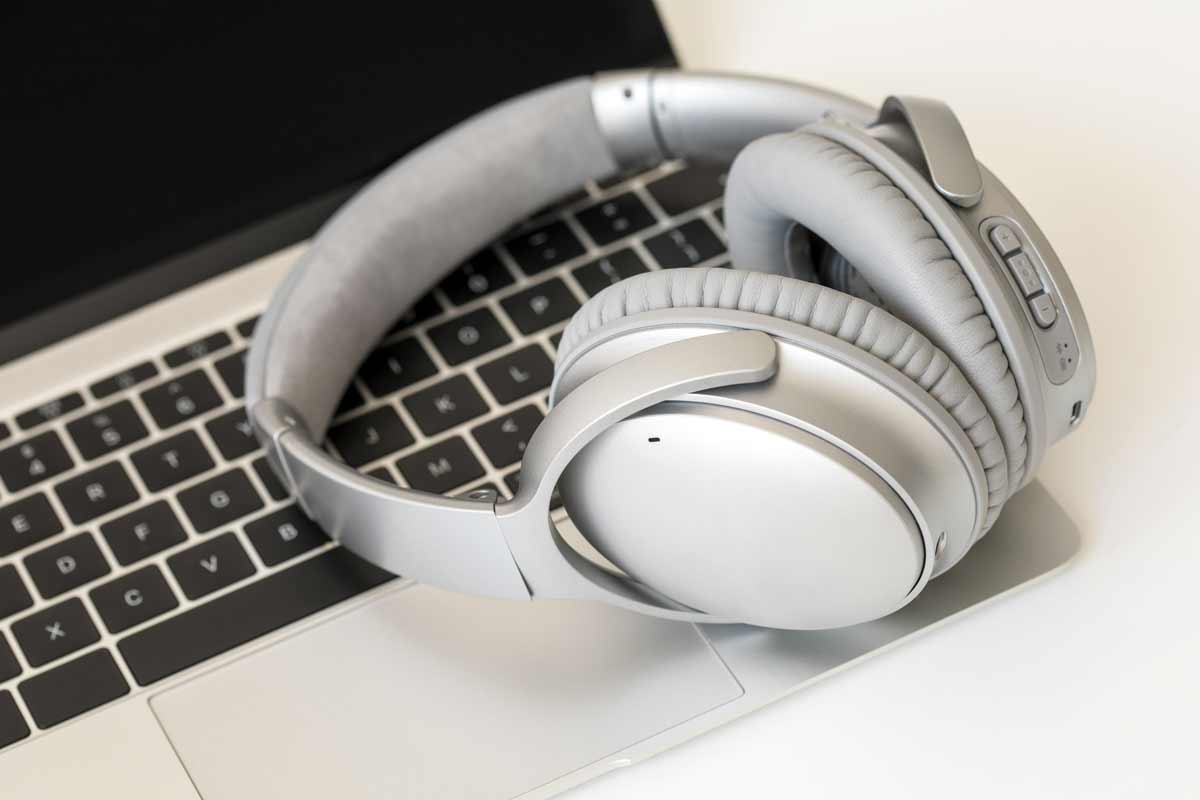
Fighting Sound with Sound
How to Choose Noise-Cancelling Headphones
In 1978, an MIT engineer named Amar Bose put on a pair of airline headphones somewhere over the Atlantic and found the engine roar so overwhelming he could barely hear the music underneath it. Instead of accepting the flight noise, he pulled out a napkin and started sketching equations before the plane landed. What he was scribbling seemed to break an intuitive rule about how sound works: you cannot fight noise by making more noise. Except, it turns out, you very much can - and the physics behind it is stranger, and more delicate, than almost anyone using these headphones every day realizes. There's also a genuinely surprising twist waiting near the end of this story: the strange "pressure" feeling some people get from noise-cancelling headphones has nothing to do with actual air pressure at all.
The Napkin on the Plane
Bose's mid-flight sketch became the foundation of the Noise Reduction Technology Group he formed the moment he landed. The idea sat mostly dormant for eight years, tested seriously for the first time in 1986, when two pilots named Dick Rutan and Jeana Yeager wore early Bose noise-cancelling prototypes while completing the first unrefueled flight around the world, a nine-day, three-minute odyssey in a two-seat aircraft called Voyager. Bose introduced the first commercial aviation headset in 1989, the U.S. Army adopted the technology for combat vehicle crews in the early nineties, and the Bose QuietComfort line arrived for ordinary consumers in 2000 - the moment noise cancellation stopped being aviation equipment and became something you'd see on a commuter train. Every noise-cancelling headphone made since, regardless of brand, descends from equations sketched on a cocktail napkin somewhere over the Atlantic.
How You Actually Fight Sound with Sound
The underlying physics is called destructive interference, and it is genuinely one of the more elegant tricks in consumer electronics. Sound travels as a wave - a rhythmic pattern of higher and lower air pressure. If you generate a second wave that's identical in every way except perfectly inverted, so that its peaks land exactly where the original wave's troughs sit and vice versa, the two waves collide and cancel each other into near-silence. This isn't a metaphor; it's the same principle behind why noise-cancelling technology is described in acoustics textbooks as "anti-noise" rather than noise blocking.
Making this happen in real life is a considerably harder problem than the physics diagram suggests. A tiny microphone on the outside of your headphone captures the ambient noise around you. An onboard processing chip analyzes that noise's frequency and amplitude, then generates a mirror-image wave - inverted, matched, and timed with almost inconceivable precision - and feeds it to the driver alongside whatever you're actually trying to listen to. The entire capture-analyze-invert-play sequence has to complete in a fraction of a millisecond, because any meaningful delay lets the original noise wave slip past before the anti-noise wave arrives to meet it, and the cancellation falls apart.
Three Ways to Listen for the Enemy
Not every noise-cancelling system samples the incoming noise the same way, and the difference explains a lot about why cheaper headphones cancel noise worse than premium ones. Feedforward systems place their microphone on the outside of the ear cup, facing outward, catching noise before it ever reaches you - fast to react, but working from a prediction of what will happen to that sound between the microphone and your eardrum, a prediction that can go wrong when your headphones shift slightly or the incoming noise changes character rapidly. Feedback systems place a second microphone inside the ear cup, listening to what's actually arriving at your ear canal after the fact, correcting the anti-noise signal in real time based on what genuinely got through - more accurate, but slower, and prone to a kind of runaway feedback howl if not engineered carefully. Hybrid systems, now the standard in every serious flagship from Sony, Bose, and Apple, use both simultaneously: the external microphone reacts fast, the internal one corrects for whatever the first one got wrong. This is precisely why hybrid systems consistently outperform single-microphone designs across a wider range of frequencies, and precisely why they cost more to build.
Why Your Airplane Seat Is ANC's Easiest Assignment
Not all noise is equally beatable, and this is the detail that explains why noise-cancelling headphones feel almost magical on a plane and considerably less magical at a dinner party. ANC excels against noise that is low-frequency, continuous, and predictable - precisely the profile of a jet engine's steady drone, an air conditioner's hum, or a train's rhythmic rumble. These are slow, repetitive waveforms that a processing chip can predict and invert with real confidence. What ANC struggles with is the opposite: sudden, high-frequency, unpredictable sound - a crying infant, a barking dog, the clatter of dishes, human speech in general - because these sounds change pitch and amplitude too erratically for even a fast processor to reliably invert in time. This is also why good ANC headphones are always paired with passive noise isolation, the simple physical seal of a snug ear tip or plush ear cup, which handles the higher frequencies electronics alone can't reliably cancel. Active cancellation and passive blocking aren't competing technologies - they're a team, each covering the part of the spectrum the other can't.
The Vacuum That Isn't There
Here's the promised twist. A remarkable number of people who use noise-cancelling headphones report a strange sensation the instant they switch ANC on: a feeling of pressure, fullness, or what online communities have taken to calling "eardrum suck" - as though the cabin were depressurizing, or an invisible hand were gently pulling on the inside of your ear. It's common enough that a widely cited Wirecutter reader survey found a majority of respondents had experienced it at least once.
The genuinely fascinating part is that this sensation is essentially never caused by any actual change in air pressure inside your ear - your headphones have no mechanism to alter it. What's actually happening is a kind of perceptual illusion, rooted in something researchers describe through signal detection theory: your brain is constantly calibrated to a baseline level of low-frequency ambient sound, largely unnoticed, providing subtle spatial and environmental cues you're not consciously aware of tracking. The instant ANC switches on and that low-frequency hum vanishes almost completely, your brain registers an abrupt, dramatic shift in the sound environment - and, because a sudden drop in low-frequency pressure cues is also what happens during a genuine altitude or depth change, your brain reaches for the nearest familiar explanation and interprets the sensation as pressure, even though nothing physical has changed at all. Some engineering analyses add a second contributing factor: many ANC systems deliberately taper off their cancellation strength as frequency rises, producing an uneven profile - strong cancellation in the bass, progressively weaker toward the treble - and that imbalance itself can heighten the illusion, since your brain loses its low-frequency spatial anchor while higher-frequency sound remains only partially reduced. It is worth knowing plainly: no peer-reviewed research links ANC to hearing damage, and the effect, while genuinely unpleasant for some people, is a trick of perception rather than physical harm - one that generally fades within minutes of removing the headphones, and tends to affect people more when they're already dealing with sinus congestion, allergies, or recent altitude changes that leave their ears more sensitized to begin with.
Why the Same Flight Sounds Different in Different Headphones
Ask frequent flyers which brand cancels a jet engine best and you'll get genuinely different answers, and the reason isn't marketing - it's that manufacturers make real, deliberate tuning choices rather than all chasing an identical target. Bose, drawing on decades of aviation-specific engineering going back to that original 1978 sketch, has historically tuned its flagship headphones toward exceptionally aggressive low-frequency cancellation, producing the kind of near-total, almost vacuum-like hush that frequent flyers associate with the brand - sometimes at the cost of a slightly less natural, more processed-feeling overall sound. Sony has tended to lean on foam ear tips and microphone arrays tuned toward stronger performance in the mid and upper frequencies, which shows up as an edge in muffling higher-pitched cabin sounds - the clatter of a cart, a crying child several rows back - even when its low-frequency cancellation runs a hair behind Bose's. Apple's more recent AirPods Pro generations, powered by increasingly capable in-house silicon, have pushed hardest on precisely calibrating the boundary between what gets cancelled and what's allowed through for situational awareness, and recent independent in-flight comparisons have found Apple's newest earbuds edging out both established rivals specifically on low-frequency engine rumble - a genuinely notable shift from just a few years earlier, when Bose's aviation pedigree made that outcome close to unthinkable. None of these differences make one brand objectively wrong; they reflect real, different engineering philosophies about which part of an airplane cabin's chaos deserves the most aggressive treatment.
What Actually Matters When You're Buying
Strip away the marketing, and a handful of concrete factors predict how well a pair of noise-cancelling headphones will actually perform. Microphone count and placement matter more than almost any spec on the box - genuine hybrid systems with multiple external and internal microphones per ear cup consistently outperform single-microphone feedforward-only designs, which is the real reason budget ANC headphones rarely compete with flagship models regardless of how loudly they advertise "active noise cancellation" on the packaging. Fit matters just as much as electronics, since ANC's entire hybrid strategy depends on passive isolation handling the frequencies electronics can't - a loose seal or an ill-fitting ear tip undermines even the best chip in the world. And if you're among the people who experience that vacuum sensation, it's worth knowing several headphones now let you dial back cancellation intensity rather than forcing an all-or-nothing choice, which for many people is enough to eliminate the discomfort entirely while keeping most of the benefit.
What began as one frustrated engineer's napkin sketch, somewhere over the Atlantic in 1978, is now a genuinely intricate negotiation between physics, psychology, and split-second signal processing - happening quietly, thousands of times a second, every time you put on a pair of headphones and the world gets a little quieter than it has any right to be.