
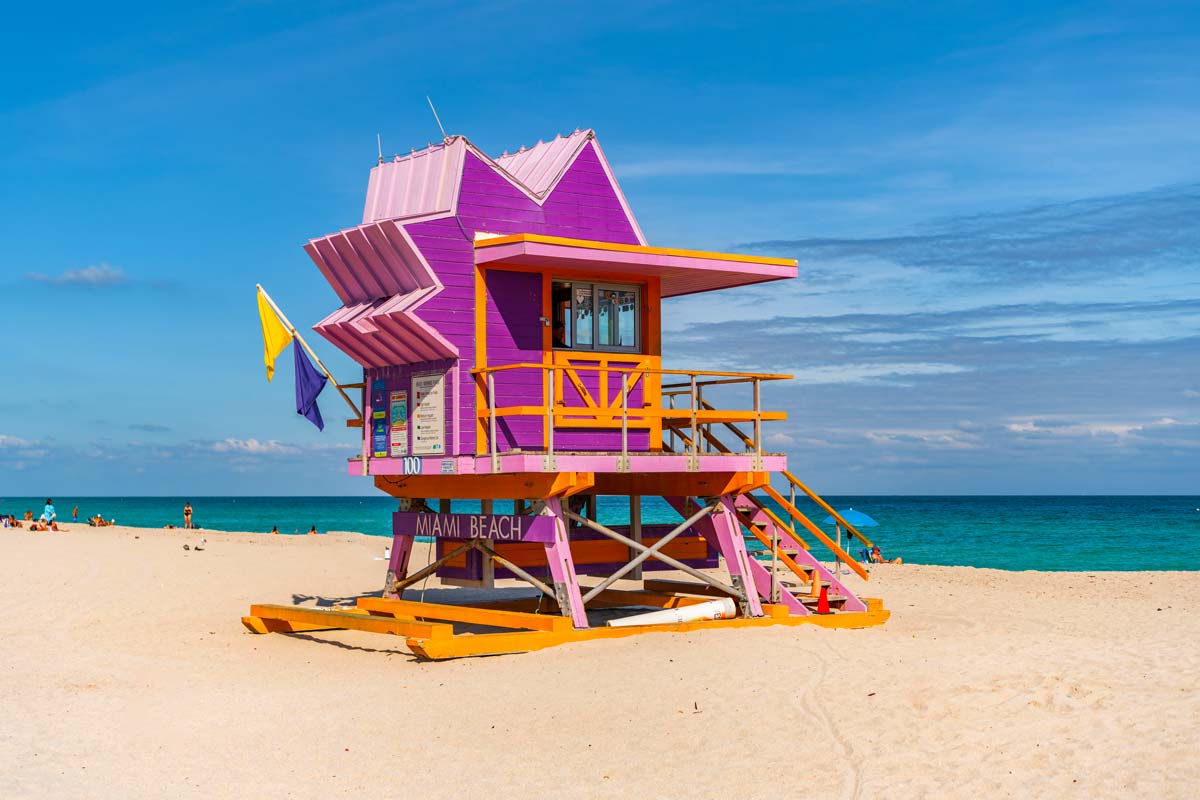
Thirty-six characters
Miami Beach
How one architect transformed lifeguard towers into an architectural manifesto - and why Miami Beach became the only place in the world where it could happen. There are certain objects people usually walk past without noticing. On most beaches around the world, a lifeguard tower is purely utilitarian - a wooden box on stilts, painted white or faded orange, designed only to function. Presence without personality. Miami Beach chose a different path.
Stretching along eight miles of Atlantic shoreline - from South Pointe Park to 87th Street - stand thirty-six lifeguard towers, and not one of them looks like another. One is purple and yellow with a roofline shaped like a frozen wave. Another is lavender-pink and elongated, with a delicate canopy reminiscent of Art Deco fashion sketches. A third glows acid green with orange accents. A fourth is sky blue with cobalt details.
Between them are coral, mint, terracotta, crimson and lemon-colored structures. More than forty color palettes. Six fundamentally different silhouettes. No repetition.
This is not chaos, and it is not whimsy. It is one of the most successful examples of public architectural identity in North America - born from destruction after one of the worst natural disasters in U.S. history.
August 1992: The Hurricane That Changed South Florida
On August 24, 1992, Hurricane Andrew struck South Florida with winds reaching 177 miles per hour. It became one of the most devastating hurricanes in American history.
Entire neighborhoods in Homestead were nearly erased. More than 160,000 homes were damaged or destroyed. Hundreds of thousands of people lost housing. Economic losses approached $30 billion - an extraordinary figure at the time. For many residents, life in South Florida became divided into two eras: before Andrew and after Andrew.
Miami Beach escaped the storm’s most catastrophic path, but much of its beachfront infrastructure, including the old lifeguard stands, was destroyed or heavily damaged.
And unexpectedly, that destruction created an opportunity.
The Architect Who Asked a Different Question
Architect William Lane was commissioned to design replacement lifeguard towers. The assignment was straightforward: functional structures, resistant to Florida’s climate, built within a modest budget.
Lane approached the project differently.
Instead of asking what a standard lifeguard tower should look like, he asked what a lifeguard tower should look like here - in Miami Beach, a city defined byArt Deco architecture, tropical light, ocean culture and visual exuberance.
His answer was radical in its simplicity: every tower should be a character.
Not standardized municipal furniture, but an individual architectural figure with its own proportions, silhouette and personality.
The first towers appeared in the mid-1990s and immediately became icons. Tourists photographed them. Fashion campaigns used them as backdrops. Architecture magazines featured them. People discussed lifeguard towers the way they discuss galleries, boutique hotels or restaurants.
Thirty-Six Architectural Personalities
Two decades later, the city returned to Lane with a larger vision: redesign the entire beachfront system.
The result was thirty-six unique structures.
Six core architectural archetypes. More than forty color combinations. Every tower visually distinct.
Each structure contains multiple layers of South Florida’s architectural DNA:
- Art Deco, the geometric visual language that shaped Miami Beach in the 1930s;
- MiMo, or Miami Modernism, with its soft curves and mid-century optimism;
- traditional Florida wooden architecture;
- tropical color palettes inspired by ocean, flora and sunlight;
- and what Lane himself described as “retro-futurism,” simultaneously nostalgic and forward-looking.
The towers stand on heavy marine-grade wooden skids reinforced with galvanized steel. This is not decorative - it is engineering. In the event of another hurricane, the structures can be moved behind the dunes without dismantling them.
Florida remembers Andrew. Its architecture remembers too. The curved aluminum roofs define the “face” of each tower. Every overhang is calculated to create shade during peak midday heat. Every proportion serves a purpose. And yet they function as sculptures as much as infrastructure.
Architecture as Civic Identity
Lane once compared the towers to the Moai statues of Easter Island.
Not as decoration, but as markers of identity and presence.
Miami Beach did not need architecturally ambitious lifeguard towers in order to operate safely. Lifeguards could have worked perfectly well in generic boxes.
But the city chose to ask a more ambitious question: what should public space feel like in a place visited daily by thousands of people?
The answer became larger than the towers themselves.
Today they function as visual shorthand for Miami Beach - as recognizable as Ocean Drive, pastel Art Deco hotels or rows of royal palms.
In 2017, the project received a Florida American Institute of Architects Merit Award for built architecture - not for a concept rendering, but for real public space executed at full scale.
The Photographer Who Couldn’t Walk Away
In 2019, photographer Tommy Kwak from New Jersey noticed a pink tower on 17th Street early one morning.
He stopped and photographed it. Then he came back the next day. And again after that.
Eventually, he spent multiple trips documenting every existing tower under different light, weather and times of day.
The result became the art book “Lifeguard Towers: Miami,” a complete photographic archive of the project.
Kwak later said he was captivated by “the electric palette and solitary forms against the ocean.” That emotional response was precisely what Lane intended from the beginning.
Why This Matters Beyond Miami
The Miami Beach lifeguard towers are not merely quirky tourist attractions.
They are a lesson in public space.
In most cities, public infrastructure is designed according to the principle of minimum adequacy: it should function efficiently and stay visually invisible. Beauty is treated as an unnecessary luxury.
After Hurricane Andrew, Miami Beach could have rebuilt cheaply and anonymously.
Instead, the city treated even its smallest public structures as part of its cultural identity. That decision changed how the shoreline feels.
Today, these towers are photographed as often as many of the citys famous hotels and landmarks.
They demonstrate something urban planners often forget: atmosphere is not created only by megaprojects. Sometimes it is shaped by the smallest structures people encounter every day.
What to See
The towers are spread across the entire Miami Beach shoreline, from South Pointe Park to the island’s northern stretches.
The best time to experience them is early morning, when the beach is nearly empty and the angled sunlight amplifies both geometry and color.
Two towers are especially worth seeking out: the structure at 10th Street, known for its dramatic angular canopy, and the iconic pink tower at 17th Street that inspired Tommy Kwak’s photographic project. The rest stand along the Atlantic like individual architectural statements.
Most people end up stopping beside them. Even if only for a moment.