
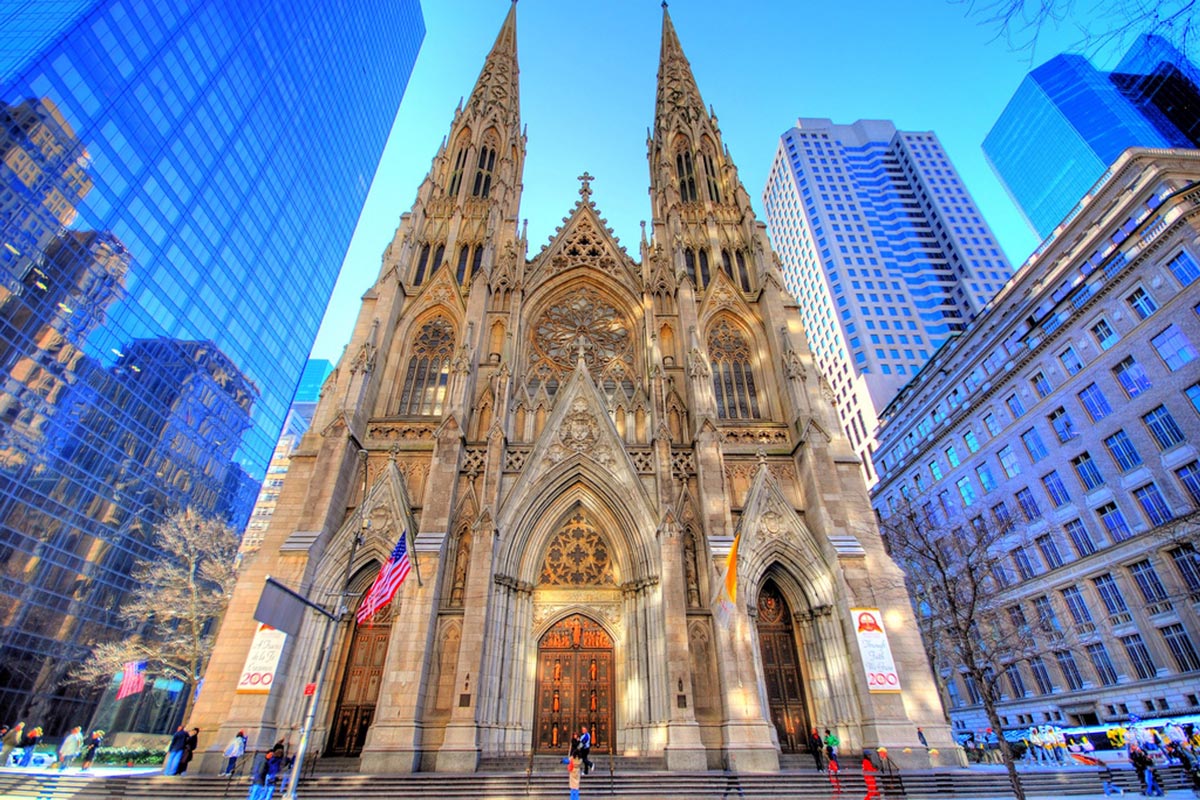
St. Patricks Cathedral in New York
Gothic silence among the skyscrapers
On Fifth Avenue, surrounded by glass, flagship boutiques, office towers and the constant movement of Midtown Manhattan, St. Patrick’s Cathedral looks almost impossible. Its white marble walls and Gothic Revival spires seem to have been carried here from another age, yet that is exactly its power. It does not disappear among the skyscrapers. On the contrary, it makes the city around it feel even more dramatic. In New York, where everything reaches upward, this cathedral reminds us that height can be not only architectural, but spiritual.
The Catholic St. Patrick’s Cathedral is one of the most famous churches in New York and one of the largest Gothic Revival Catholic cathedrals in North America. It occupies an entire city block between Fifth Avenue, Madison Avenue, 50th Street and 51st Street, directly across from Rockefeller Center. For a visitor, it is a striking landmark. For believers, it is an active cathedral, a place of prayer, Mass, silence and memory. For the city itself, it is an architectural sign of how New York changed through waves of immigration, ambition and faith.
From a small cathedral to a growing city
The present cathedral had a predecessor: Old St. Patrick’s Cathedral on Mulberry Street in Lower Manhattan. It was built between 1809 and 1815 and long served as the centre of Catholic life in New York. By the middle of the nineteenth century, however, the city was changing rapidly. Thousands of Catholic immigrants were arriving in New York: Irish, Italians, Germans, people from Austria-Hungary and other parts of Europe. The old cathedral could no longer hold the growing community.
In 1853, Archbishop John Joseph Hughes announced his intention to build a new cathedral in the centre of Manhattan. To many, the idea seemed almost absurd. The chosen site was far north of the city’s active life at the time and was seen as being on the edge of town. The project was even mocked as “Hughes’ Folly.” But the archbishop saw the future differently. He was convinced that the city would grow and that one day the new cathedral would stand not on the margins, but in the heart of New York.
That is exactly what happened. Today, it is hard to imagine a more symbolic location: a Gothic Revival church standing across from Rockefeller Center, in one of the most expensive and dynamic urban environments in the world. What once seemed risky turned out to be prophetic.
Construction, war and the long road to completion
The cornerstone of the new cathedral, designed by architect James Renwick Jr., was laid in 1858. Renwick was already known for the Smithsonian Institution Building in Washington, but St. Patrick’s Cathedral became his great New York masterpiece. He chose the language of Gothic Revival, a style that connected the new American city to the great European tradition of church architecture.
Construction was soon interrupted by the Civil War, when money, labour and stability were all in short supply. Work resumed after the war, and the cathedral opened to worshippers on May 25, 1879, after Archbishop Hughes had already died. But the building’s story did not end there. The spires were completed in 1888, the Lady Chapel in the early twentieth century, and the cathedral was formally consecrated only in 1910, after the construction debt had been paid.
The cathedral has been restored several times. Especially visible was the major restoration of the twenty-first century, after which the marble walls and spires regained a light, almost creamy-white tone. For New York, this was an important visual moment: a church that had darkened for decades from exhaust, pollution and acid rain once again looked closer to the image intended by its creators.
Architecture: verticality, light and urban contrast
The cathedral impresses with its scale. It stretches for more than 100 metres, and its spires rise roughly 100 metres above Fifth Avenue. Thousands of people can fit inside, yet the space does not feel merely large. It works differently: the eye is drawn upward, the lines rise toward the vaults, light passes through stained glass, and the noise of Manhattan remains behind the bronze doors.
The main entrance faces Fifth Avenue. The bronze doors were installed in the mid-twentieth century. Each leaf weighs several tons, yet the doors are so precisely balanced that they can be opened by hand. They depict saints important to the history of the Catholic Church in New York and America, including Saint Patrick, Saint Frances Xavier Cabrini, Saint Kateri Tekakwitha and Saint Elizabeth Ann Seton, the first native-born American canonized by the Catholic Church.
Inside, the cathedral unfolds as a space of English Gothic Revival: pointed arches, high vaults, side chapels, an altar, stained glass and warm half-shadow. There is no museum-like stillness here. This is an active church, where visitors with cameras pass beside people who have come to light a candle, pray or simply sit in silence for a few minutes.
The Lady Chapel, stained glass and the Pietà
One of the most elegant parts of the cathedral is the Lady Chapel, located at the eastern end of the church. It was built in the early twentieth century to a design by Charles T. Mathews and decorated with magnificent stained glass made in England. These windows were created and installed over many years, filling the space with soft coloured light.
Near the Lady Chapel stands the Pietà by American sculptor William Ordway Partridge, created in 1906. It is considerably larger than Michelangelo’s famous Pietà in St. Peter’s Basilica in Rome and creates a very different impression: not intimate and Renaissance in feeling, but more monumental, emotional and dramatic.
Other important places inside the cathedral include altars dedicated to saints, chapels for prayer, the organ, the crypt and memorial elements connected with the history of the Archdiocese of New York. Near the entrance, visitors can see a bust of Pope John Paul II, installed in memory of the Pope’s visit to the cathedral. For New York Catholics, St. Patrick’s Cathedral is not only architecture, but a living memory of the community.
The cathedral and Rockefeller Center: one of New York’s strongest images
One reason St. Patrick’s Cathedral is photographed so often is its extraordinary urban contrast. Directly across Fifth Avenue stands Rockefeller Center, one of the symbols of business and cultural Manhattan. At the entrance to the complex is the bronze statue of Atlas by Lee Lawrie. The image of the ancient titan holding the heavens with the Gothic façade of the cathedral behind him has become one of New York’s most recognizable visual dialogues.
This contrast works almost as a metaphor for the city. On one side: commerce, media, offices, shops, the Rockefeller Center Christmas tree and the energy of modern Manhattan. On the other: a church built by an immigrant community that was once still fighting for its place in American society. Between them lies Fifth Avenue, crossed each day by thousands of people.
St. Patrick’s Day: when the cathedral becomes the centre of the city
Every day, the cathedral lives an intense spiritual life: Masses, confessions, prayers, sacred music concerts and important events of the archdiocese take place here. But once a year, on March 17, St. Patrick’s Cathedral becomes especially visible as a centre of New York. On St. Patrick’s Day, the famous parade moves along Fifth Avenue - one of the oldest and largest of its kind in the world.
Green clothing, Irish flags, bagpipes, school and community groups, families, tourists and a vast crowd turn Midtown into a celebration of Irish heritage. But at the centre of this urban energy remains the cathedral dedicated to the saint associated with bringing Christianity to Ireland. The parade is preceded by a festive Mass, and in that moment the history of immigration, religion and city identity comes together with particular clarity.
Why you should go inside
St. Patrick’s Cathedral is easy to treat as just another mandatory Midtown landmark. That would be a mistake. Its value is not only that it is beautiful, famous and conveniently located near Rockefeller Center, Saks Fifth Avenue and the Museum of Modern Art. Its real power lies in the rare pause it creates inside America’s loudest city.
It is worth entering not only for photographs. Stand outside and look up at the spires. Step inside and allow your eyes to adjust to the dimness. Notice the stained glass, bronze doors, side chapels, Lady Chapel, Pietà, candles and the people who have come not as tourists, but as parishioners. Then step back out onto Fifth Avenue, where the noise, taxis, shop windows and skyscrapers immediately return.
That is what makes St. Patrick’s Cathedral one of New York’s strongest places. It does not try to argue with the city, and it does not hide from it. It stands in the very centre of Manhattan as a reminder that even in a city of speed, money and vertical growth, there must still be room for silence, memory and light.