
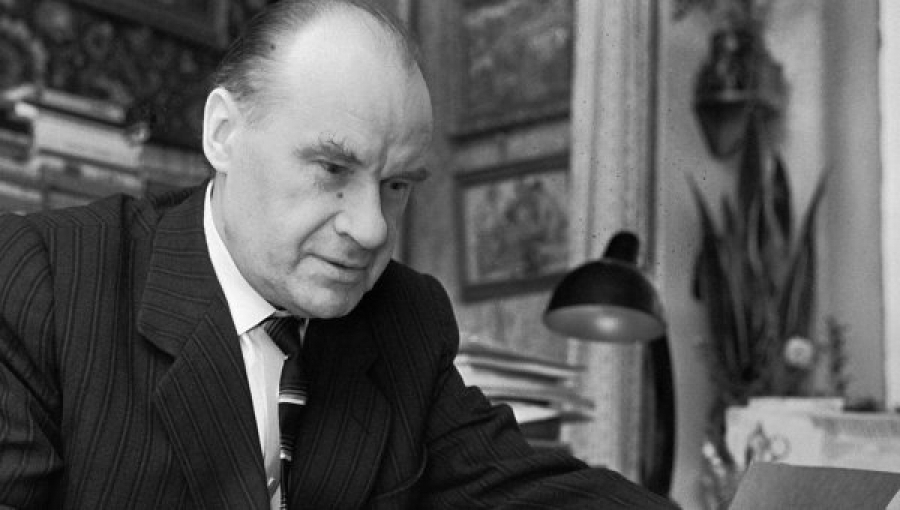
The Dunno on the moon - a secret message from Nikolai Nosov
Nikolai Nosov novel Dunno on the Moon written in 1964 is a mirror of modern reality. It is a story about a world ruled by the hunger for money, profit, and entertainment - a world that turns people into sheep.
Worldview: “Why do rich people need so much money?” Dunno wondered. “Can a rich man really eat up several million?”
“Eat up!” Goatling snorted. “If only they merely ate! A rich man fills his belly first, and then begins feeding his vanity.”
“What kind of vanity is that?” Dunno did not understand.
“Well, that is when you want to throw dust in other people’s eyes.”
Joint-Stock Companies: “We also do not wish to say that, by buying shares, the little people acquire nothing at all; for by buying shares, they acquire the hope of improving their welfare. And hope, as everyone knows, is worth something too. Nothing comes for free, as the saying goes - even a sore will not settle on you for nothing. Everything must be paid for with money, and once you have paid, you may at least dream.”
Advertising: “Such are the customs of the moon dwellers! A little lunar man would never eat sweets, gingerbread, bread, sausage, or ice cream from a factory that does not place advertisements in magazines, nor would he go to a doctor who has not invented some mind-boggling advertisement to attract patients. Usually, a moon dweller buys only those things he has read about in the newspaper; and if he sees a cleverly composed advertisement on some wall, he may even buy something he does not need at all.”
Monopolization of the Economy: “The best way out of the present situation is to begin selling salt even cheaper. The owners of the small factories will be forced to sell salt at too low a price; their little plants will begin operating at a loss, and they will have to shut them down. And then we shall raise the price of salt again, and no one will prevent us from accumulating capital.”
Control Over Technology: “Can you imagine what may happen when these giant plants appear on our planet? There will be an abundance of food. Everything will become cheap. Poverty will disappear! Who, in that case, will want to work for you and me? What will become of the capitalists? Take you, for example: you have now become wealthy. You can satisfy every whim. You can hire a chauffeur to drive you in a car, hire servants to carry out all your orders - to clean your rooms, look after your little dog, beat your carpets, pull on your gaiters, and who knows what else. But who is supposed to do all this? Poor people who need wages must do it for you. And what poor person will enter your service if he needs nothing? You will have to do everything yourselves. Then what will all your wealth be for? If such a time ever comes when everyone lives well, then the rich will certainly live badly. Keep that in mind.”
Black PR: “And so, can the Society of Giant Plants collapse?” Grizzle, the newspaper editor, asked warily, twitching his nose as if sniffing something out.
“It must collapse,” Krabs replied, emphasizing the word “must.”
“Must?… Ah, it must!” Grizzle smiled, and his upper teeth once again dug into his chin. “Well then, collapse it shall, if it must - I assure you! Ha-ha!…”
The State of Science: “Dunno asked why the lunar astronomers, or lunologists, had still not built a flying machine capable of reaching the outer shell of the Moon. Memega said that building such a machine would be far too expensive, while lunar scientists had no money. Money belonged only to the rich, and no rich man would ever agree to spend funds on a matter that promised no large profits.
“The rich people of the Moon are not interested in the stars,” Alpha said. “Like pigs, the rich do not like raising their heads to look upward. They are interested only in money!”
Legality: “And who are these policemen?” Herring-Girl asked.
“Bandits!” Kolosok said irritably. “Honestly, bandits! In theory, the duty of the police is to protect the population from robbers; in reality, they protect only the rich. And the rich are the real robbers. They simply rob us under the cover of laws they have invented themselves. Tell me, what difference does it make whether I am robbed legally or illegally? It is all the same to me!”
Police Techniques: “What do you think this is?” the policeman asked. “Come on, smell it.” Dunno cautiously sniffed the tip of the baton.
“A rubber stick, I suppose,” he muttered.
“A ‘rubber stick’!” the policeman mimicked him. “That just shows what a donkey you are! This is an advanced rubber baton with an electric contact. Abbreviated - ARBEC. Now then, stand at attention!” he commanded. “A-a-arms at your sides! And no t-t-talking!”
Methods: “There was a strong resemblance between Migle and Figle: both had prominent cheekbones and broad faces; both had low foreheads and dark, coarse hair cut like a brush, beginning almost at their eyebrows. Despite their great outward resemblance, Figle and Migle differed greatly in character. While Figle was an angry little man who, as he himself claimed, tolerated no talking, Migle, on the contrary, was very fond of talking and even joking. As soon as the door closed behind Figle, Migle said to Dunno:
“Allow me to report, my dear fellow, that in this entire police department the first person is me, because the first thing you see when you come in here is none other than my face. Hee-hee-hee! Is that not a witty joke?…
“…Do you know who you are?”
“Who?” Dunno asked in fright.
“A famous bandit and raider named Pretty Boy, who has committed sixteen train robberies, ten armed bank raids, seven prison escapes - the last one last year, after bribing the guards - and stolen valuables worth a total of twenty million fertings!” Migle announced with a joyful smile.
Dunno waved his hands in confusion.
“What are you saying! What are you saying! That is not me!” he said.
“Oh yes, it is you, Mr. Pretty Boy! Why be embarrassed? With money like yours, you have absolutely nothing to be embarrassed about. I imagine that of those twenty million you still have something left. You have certainly hidden something away. Now give me just one hundred thousand from those millions of yours, and I will let you go. After all, no one besides me knows that you are the famous robber Pretty Boy. And instead of you I will put some tramp in jail, and everything will be in perfect order, on my honour!
“…Well, give me at least fifty thousand… Well, twenty… I cannot go lower, honestly! Give me twenty thousand and be off wherever you please.”
Credit: “I had got a job at the factory then and began earning decently. I even started putting money aside for a rainy day - in case I suddenly became unemployed again. But of course, it was hard to resist spending the money. And then everyone kept saying that I ought to buy a car. I said: why do I need a car? I can walk. And they said: it is shameful to walk. Only poor people walk. Besides, you can buy a car on instalments. You make a small down payment, get the car, and then pay a little every month until the whole amount is paid off. So that is what I did. Let everyone imagine, I thought, that I am rich too. I paid the first instalment and got the car. I sat down, drove off, and immediately went cra-a-ash into a di-i-itch - Goatling even began stuttering from agitation. I wrecked the ca-a-ar, you see, broke my leg, and four ribs as well.
“Well, did you have the car repaired afterward?” Dunno asked.
“Of course not! While I was sick, they fired me from work. Then the time came to make the next car payment. But I had no money! So they told me: give the ca-a-ar back then. I said: go and take it from the di-i-itch. They wanted to sue me for damaging the car, but when they saw there was nothing to take from me anyway, they left me alone. So I ended up with neither the car nor the money.”
Medicine: “The doctor examined the patient carefully and said that it would be best to place him in a hospital, since the illness was very advanced. When Dunno learned that treatment in the hospital would cost twenty fertings, he became terribly upset and said that he earned only five fertings a week and would need a whole month to collect the necessary sum.
“If you wait another month, the patient will no longer need any medical help,” the doctor said. “To save him, treatment must begin immediately.”
The Media: “There were The Business Wit, The Newspaper for the Plump, The Newspaper for the Thin, The Newspaper for the Clever, and The Newspaper for Fools. Yes, yes! Do not be surprised: exactly The Newspaper for Fools. Some readers may think it unwise to call a newspaper by such a name, for who would buy a paper with that title? After all, no one wants to be considered a fool. Yet the inhabitants paid no attention to such trifles. Everyone who bought The Newspaper for Fools said he bought it not because he considered himself a fool, but because he was curious to know what was being written there for fools. Incidentally, the newspaper was run very intelligently. Everything in it was understandable even to fools. As a result, The Newspaper for Fools sold in huge numbers…”
The System as a Whole: “…Anyone who has money can settle quite comfortably even on Fool’s Island. For money, a rich man will build himself a house where the air is well purified, pay a doctor, and the doctor will prescribe pills that make the wool grow more slowly. In addition, there are so-called beauty salons for the rich. If some rich man inhales harmful air, he immediately runs to such a salon. There, for money, they begin applying all kinds of poultices and rubs to make his sheep’s muzzle resemble an ordinary little person’s face. True, these poultices do not always work very well. Look at such a rich man from a distance, and he seems like a normal little person; look more closely, and he is the simplest sheep.”
“…A great bedlam gathered in Mr. Spruts’s office around a large round table… Having learned what danger threatened them in connection with the appearance of giant plants, the members of the bedlam grew agitated and, as one, joined Mr. Spruts’s proposal. He said that the entire affair of the giant plants had to be killed in the cradle - that is, before it developed to full strength… ‘So, we are supposed to give them three million fertings?’
‘Quite right,’ Mr. Spruts confirmed. ‘We are to give it to them.’
‘And not they to us?’
‘No, no. Not they to us, but we to them.’
‘Then it is not profitable for us,’ Skryagins declared. ‘If they gave us three million, that would be profitable; but if we give it to them, it is not profitable…’”