
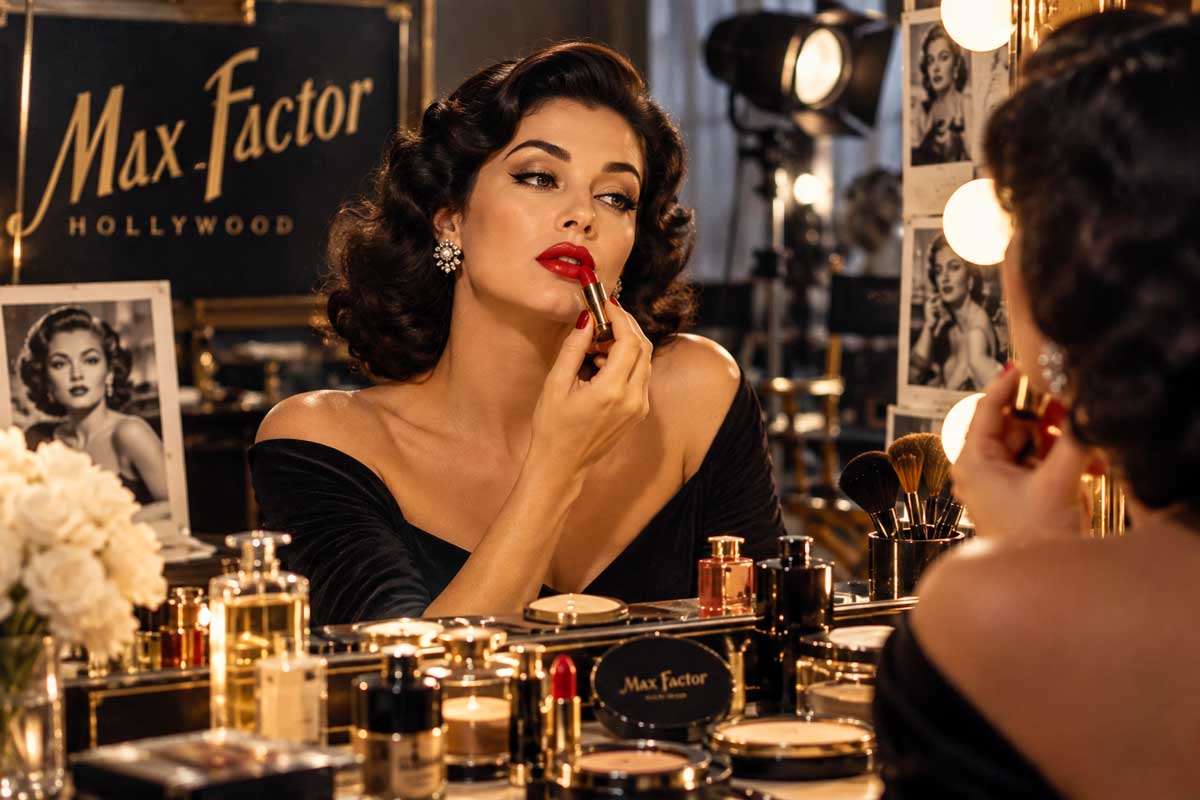
The Man Who Invented the Hollywood Face: Max Factor
How a wigmaker from Ryazan taught the movie camera to love the human face
Before makeup became an industry, it was a compromise. Stage greasepaint had to be visible from the back row, so it sat on the face like a heavy mask. In everyday life, cosmetics were long considered faintly disreputable: actresses, dancers and women of the stage wore them, but "respectable" ladies did not. And the cinema, born at the turn of the century, proved especially cruel to the human face. The camera saw too much and rendered it too crudely. Skin turned chalky, lips vanished, eyes became dark hollows, and the old theatrical greasepaint cracked under the hot lights.
That was the moment a man with an almost unbelievable life story arrived in America: a hairdresser and makeup artist from the Russian Empire whose path had led from small workshops and theatre stages to the imperial court, then to emigration and, finally, to Hollywood. His name was Maksymilian Faktorowicz. In the United States he became Max Factor, and in time that name grew into one of the most recognizable cosmetics brands of the twentieth century.
The Max Factor story is more than the story of a successful company. It is the story of how the very idea of beauty changed. Of how greasepaint became makeup, how film stars became style icons, and how women around the world began buying not a jar of powder but a promise: to look a little closer to the dream on the screen.
From the Imperial Provinces to the Language of Hollywood
Maksymilian Faktorowicz was born in the Polish part of the Russian Empire, into a Jewish family of very modest means. A childhood in that world rarely left room for a proper education: children went to work early, a trade counted for more than theory, and the family's survival came before anyone's personal ambitions. Early on, Faktorowicz found himself close to the theatre and the apothecary's trade, to wigs, scents and pigments, to that particular world in which appearance could be not merely adorned but created anew.
This matters. He came to cosmetics as a craftsman, not as a merchant of dreams. He understood the face in technical terms rather than abstract ones: how colour settles on the skin, what light does, how features change under makeup, why a wig should look less like a wig than like part of the person wearing it. That was where his future strength lay. Max Factor could never have grown out of a pretty legend alone. It grew out of mastery.
After his army service, Faktorowicz settled in Ryazan, where he opened a barbershop and a small store selling his own products: creams, rouges, fragrances, wigs. Provincial Russia at the end of the nineteenth century seems a world away from Hollywood, yet it was there that the guiding principle of his future empire took shape: beauty should be made by hand but look natural. The customer may want magic, but the product has to work.
According to recollections and various biographical accounts, Faktorowicz's talent caught the eye of theatrical circles and members of high society. His work involved stage makeup, wigs and costume looks, and later the imperial theatres. This part of the story has an almost cinematic shimmer, but the court legend is not the point. The point is that Faktorowicz learned to serve the most demanding clients of all, people for whom appearance was not decoration but part of their status, their role and their power.
Emigration as Escape and Fresh Start
The early twentieth century was a dangerous time. Pogroms, restrictions and social upheaval made the future impossible to predict. Faktorowicz decided to leave for America. There was nothing romantic about it. It was a risky break with his old life for the chance to survive and begin again.
In the United States, his name was simplified to Max Factor. Sometimes that is exactly how great brands are born: not around a marketing agency's conference table, but in immigration papers, where a difficult surname gets trimmed to fit a new country.
First came St. Louis. There Factor kept doing what he did best: hair, makeup, skin care, cosmetics. But his real turning point lay further west.
Los Angeles in the early 1900s was not yet the capital of world cinema in the modern sense. It was a place for experiments: sunshine, cheap land, young studios, new directors and actors, and a mass culture just learning how to speak to its audience.
Factor arrived at exactly the right time. In 1909 he founded Max Factor and Company. On the surface, it was a shop selling professional supplies to makeup artists, hairdressers and actors. In reality, it was the laboratory of the Hollywood to come. He sold wigs, cosmetics, greasepaint, products for stage and screen. But he soon realized that film demanded a new kind of face.
The Camera Problem
The stage and the camera are two different worlds. Theatrical makeup is designed for distance. It is coarse, high-contrast, heavy. The camera, by contrast, comes in close. It forgives no extra layer, no unnatural colour, no poor texture. In the silent era, an actor's face had to be expressive, and the old products couldn't keep up: greasepaint dried out, cracked and looked like a mask.
Factor began creating products specifically for film. His approach was almost an engineer's. He had to account for the lighting, the film stock, sweat, the close-up, skin tone, the expression in the eyes, the movement of the face. He wasn't just selling cosmetics; he was solving a technical problem for a brand-new industry.
In the 1910s he developed a more flexible makeup for screen actors. The company would later claim he had created the first true "make-up" for the movies in the modern sense. The history of both the term and the industry is more tangled than that, but Factor's real contribution was enormous: he helped turn greasepaint from a theatrical mask into a system for correcting, enhancing and sculpting the face.
It was a turning point. Makeup was no longer only a way to hide behind a role. It became a way to be seen.
Hollywood as a Showcase for Dreams
Factor was also quick to grasp what would later become the foundation of the entire beauty business: women want more than a product. They want a connection to a way of life. If an actress looks unforgettable on screen, the woman in the audience wants to know how it was done. Offer her the same shade, the same powder, the same mascara, and she isn't buying a jar. She is buying a small piece of Hollywood.
The brand was one of the first to harness the power of film stars to sell cosmetics in a systematic way. It suited the studios too: actresses became even more recognizable, their faces turned into advertising symbols, and the films gained an extra layer of glamour. Max Factor sat at the centre of that exchange. He worked with Hollywood, and Hollywood worked for him.
The scale of that idea is worth taking in. Today, celebrity beauty feels perfectly ordinary: actresses, singers and influencers launch brands, front lipstick campaigns and film videos for social media. But in the first half of the twentieth century, it was a new cultural mechanism. Factor was among the first to see that screen beauty could be reproduced. It could be packaged, labelled, put on a counter and sold to millions of women.
Pan-Cake: When Technology Became Fashion
One of the company's great breakthroughs was Pan-Cake Make-Up. It arrived in the 1930s in response to the demands of colour film, Technicolor above all. Colour stock rendered skin in a new way and called for a different makeup texture. The old products performed badly: a face could come out blotchy, flat, unnatural.
Pan-Cake was dense yet comfortable to wear. It went on with a damp sponge, gave an even matte finish and held up well under studio lights. It was made for professionals, but it quickly became clear that ordinary women wanted the same result. Studio staff, actresses and salon clients began buying it not as a technical product for the camera but as makeup for everyday life.
It was a brilliant crossover: a product born on the film set became a mass-market beauty hit. It stood for a new standard of the face - smooth, photogenic, controlled. At a time when women were stepping ever more into public life, going to work, going to the movies and reading magazines, makeup was becoming neither a luxury nor a sign of frivolity but part of the modern woman's image.
Max Factor found itself at the intersection of two revolutions: the technical revolution of cinema and the social revolution of women's visibility.
The Face Factory
By the 1930s, Max Factor was far more than a supplier of greasepaint. It was a factory of images. The company served the studios, made professional products, crafted wigs, developed colour palettes, and opened luxurious spaces for consultations and makeovers. Los Angeles acquired an architecture of beauty all its own: salons, laboratories and private rooms where a face was studied almost like a design project.
Factor was obsessed with the individuality of each face. His famous approach was never about making everyone look the same, but about matching a look to a type. For Hollywood, that mattered enormously: a star had to be recognizable. She needed her own lips, her own brows, her own shade, her own hairline, her own light.
The mass market, though, is always more complicated. The bigger a brand grows, the stronger the temptation to create a universal ideal. Max Factor individualized beauty and standardized it at the same time. It taught women to bring out their own features, but through images dictated by screen culture.
That is the brand's duality. It gave women new tools for self-expression while reinforcing the power of the glossy ideal. It democratized makeup while making the face part of an industry of expectations. It promised confidence, but sold it through comparison with unattainable stars.
After Max
Max Factor died in 1938. The business passed to his family, chiefly his sons, and the brand kept growing. But growth brought new challenges. The Second World War upended supplies, raw materials, packaging and consumer habits. Metal gave way to cheaper materials, production was reorganized, and the market grew tougher.
After the war, cosmetics became more of a mass product than ever, and competition intensified sharply. Revlon, Coty, Elizabeth Arden, Helena Rubinstein and others understood the power of advertising, television and new retail formats. Hollywood was no longer the only centre of influence. Television was coming into people's homes, magazines were growing more aggressive, and women wanted to look not only "like a movie star" but "modern, active and independent."
For Max Factor, this was painful. Its greatest advantage, its closeness to Hollywood, was slowly losing its exclusivity. The golden age of the studio system was drawing to a close, and with it went an era in which a single makeup house could act as the near-official architect of screen beauty.
The company tried to adapt. It launched new products, expanded abroad, moved into skin care, fragrance, youth lines and men's grooming. But the market was already playing by different rules.
In the 1970s, the family's control of the brand came to an end when Max Factor was sold. A long corporate life followed: one owner after another, shifting strategies, attempts to hold on to a legacy in a world where cosmetics were becoming ever faster, more fragmented and more global.
From Family Legend to Corporate Asset
In the 1990s the brand landed at Procter and Gamble, and then, after a major deal, moved to Coty. Today Max Factor is part of the portfolio of a large international beauty group. It is no longer a family laboratory in Hollywood, nor a salon where actresses come for a look of their own. It is a global brand with history, name recognition and a difficult task: staying relevant at a time when younger shoppers often pass over the old legends in favour of micro-brands, niche lines, clean beauty and skincare-first makeup, products that promise the naturalness of the future rather than the glamour of the past.
That puts Max Factor in a fascinating position. Its heritage is enormous, but the word "heritage" can be an asset or a burden. To some shoppers it signals quality and a professional pedigree. To others it is something from their mother's or grandmother's makeup bag, a brand that needs to be explained all over again.
And that is the central challenge for every old beauty house. History alone no longer sells. It has to be translated into a new language.
Why the Story Still Matters
At first glance, Max Factor is a charming retro tale: an immigrant, Hollywood, stars, red lips, black-and-white film, powder made for Technicolor. Look a little deeper, though, and it is the story of how an industry of desire is born.
Max Factor understood that beauty is not just biology and not just taste. It is technology, a social code, light, the camera, packaging, the authority of a celebrity, the dream of another version of yourself. He didn't simply make cosmetics. He built a bridge between professional makeup and women's everyday lives.
Before him, makeup was either a tool of the stage or an object of moral suspicion. After him, it became a language. Women began using cosmetics not only to hide flaws but to build an image: businesslike, romantic, dramatic, cinematic, confident.
Today, of course, we see it differently. Our culture is warier of imposed beauty standards. We understand that makeup can liberate and it can constrain. It can be play, or it can become a dependence on other people's judgment. It can give confidence, or it can breed anxiety. But that is exactly why the Max Factor story feels so current: it shows that the beauty industry was never just about lipstick and powder. It was always about the power of the image.
The Immigrant Formula for Success
For our readers, the story has one more dimension. Max Factor is the story of an immigrant caught between cultures who turned that position into strength. He brought to America a craft shaped in Europe and the Russian Empire, yet he understood his new country faster than many people born there. He saw that the United States was building not only factories and cities, but myths. Hollywood was the great myth of the century, and Factor gave it a face.
An immigrant often starts at a disadvantage: an accent, a foreign name, no connections, the need to prove professional credentials all over again. But there is an advantage too: the ability to see the familiar from the outside. Max Factor saw American film not as entertainment but as a new factory of identity. And he built his business exactly where others saw nothing more than a film set.
That ability, to spot a market before it has even understood itself, is what makes an entrepreneur a real one.
A Face That Outlived Its Era
Max Factor no longer rules Hollywood the way it once did. The beauty world has grown too big, too fast and too democratic. Stars no longer live only on the screen; they live in your phone. Makeup is no longer dictated by a studio. But the core principle that made Max Factor great hasn't gone anywhere.
Beauty has to work in real life. Not in some abstract ad. Not only on a model's face. Not only under perfect lighting. It has to hold up to the camera, to a long day, to movement, emotion and close distance. That is what Factor understood first: a woman isn't buying paint. She is buying a way to be fully present.
Seen that way, his legacy reaches far beyond a single brand. Every foundation that promises a "second-skin" finish, every mascara designed for a more expressive gaze, every campaign starring an actress or an influencer, every product that has made its way from the professional kit into an everyday makeup bag carries on, to some degree, the same logic.
Max Factor didn't just change the faces of Hollywood. He changed the way millions of people look at their own.
That is why his story never feels like a museum piece. It has everything the twentieth and twenty-first centuries love: emigration, craft, cinema, marketing, technology, illusion, ambition, and a deeply human wish to see in the mirror not only who you are today, but who you could become.