
Interesting facts about the Pentagon
Washington, D.C.
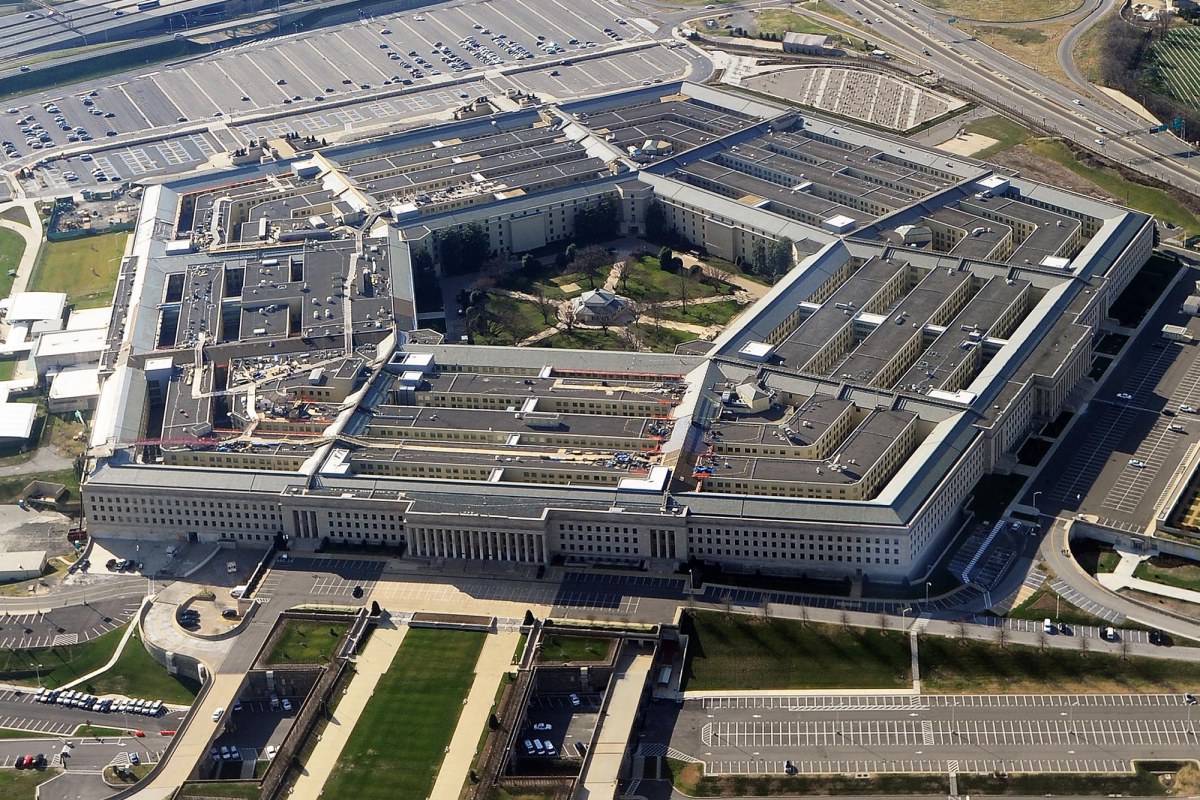
The Pentagon is the largest office building in the world, a structure that impresses not only with its sheer size, but also with its unmistakable shape. Today, it is a symbol of the United States Armed Forces, and the word Pentagon itself is often used as a synonym for the U.S. Department of Defense. Let us look at a few fascinating facts about this remarkable building…
Originally, the building was not constructed for the Department of Defense, but by the time the work was completed, the military establishment had outgrown the offices it occupied and needed new premises.
Sometime around 1940, the American administration came up with a rather bold idea: to place the entire U.S. Department of Defense in one building. That meant no fewer than 26,000 employees scattered across 17 separate buildings in the District of Columbia. Moreover, according to the technical specifications, this future citadel was supposed to comfortably accommodate 40,000 people at the same time! World War II was gaining momentum in Europe, and the United States could enter the war at any moment - and yet this was the idea they were considering. Somehow it did not seem entirely logical: all the key military leaders gathered under one roof. Even the top executives of Coca-Cola, who know the secret formula of the drink, do not fly on the same airplane.
Nevertheless, immediately after receiving the president’s approval, the architects began searching for a site on which to build this citadel. In Arlington, a suburb of Washington, they chose a particular plot of land that had once been expropriated. Masters of feng shui would probably have envied them. What made the site especially attractive was that the land was outlined by five roads, some of which intersected at an angle of 108 degrees. To most people, of course, that would not have meant much, but architects are strong in geometry, and they knew perfectly well that lines meet at such an angle in an equilateral pentagon - the figure the ancient Greeks called a pentagon.
It will probably remain a mystery to us which came first: the site discovered by the designers, or the design for which the site was deliberately chosen. It should be said that the location was quite swampy, and very close to it stood the famous Arlington Cemetery, where American servicemen were buried - hardly the best place for construction. Feng shui masters would probably not have approved, but the U.S. president apparently knew more than Chinese geomancers: the land for construction was approved. Roosevelt’s only instruction, at the request of his wife, was to move the future building about half a mile so that it would not block the view from Arlington Cemetery toward Washington.
Amazingly, the largest building of the 20th century was erected in just 16 months and was ready by mid-January 1943. The monolithic structure was built in the neoclassical style. The simplicity of the design was of fundamental importance under wartime conditions. The Pentagon was built of sand and reinforced concrete, supported by 41,492 concrete piles. Indiana limestone was used as the facing material. Marble was rejected because its supplier was fascist Italy, and cooperation with that country was out of the question during the war. Ultimately, the construction of the Pentagon cost American taxpayers more than $83 million. The perimeter of the building is 1,405 metres, and the length of one side of the pentagon is 281 metres. The total floor area is 604,000 square metres. The total area of the complex is approximately 2.5 million square kilometres. The walls of the Pentagon contain 7,754 windows. The Pentagon’s corridors stretch for 28 kilometres and form a confusing labyrinth. The concentric rings of the Pentagon are connected by 21 bridges. The height of the above-ground part of the building is 23.5 metres. In addition to its above-ground floors, the Pentagon also has two underground floors. On the other hand, it is still claimed that the Pentagon remains one of the most ergonomically efficient buildings ever designed. The building is crossed at the centre by ten corridors, which connect the five pentagons radiating from the middle. As a result, an employee of the U.S. military establishment can reach any point along the building’s perimeter in no more than seven minutes.
This natural ergonomics is connected to the properties of the geometric figure itself. The diagonals of a pentagon form a pentagram, and the points where the diagonals intersect in a regular pentagon are always points of the “golden ratio.” At the same time, they form another pentagon, which, when its diagonals are drawn, inevitably creates yet another one - and so on endlessly. Thus, the pentagon seems to consist of an infinite number of pentagons formed by the intersections of its diagonals. This endless repetition of the same geometric figure creates a sense of rhythm and harmony that our mind registers subconsciously.
However, it was probably not only ergonomic advantages that led the American military to choose the form of a regular pentagon. Symbolism itself played a major role. Let us turn again to Plato. The famous philosopher considered the dodecahedron - a twelve-sided solid made up of twelve pentagons - to be the most perfect geometric body. Plato claimed that it was precisely this form that “God used as a model in arranging the Universe.” In 2003, during the analysis of data from NASA’s WMAP spacecraft, a hypothesis was proposed that the Universe is a Poincaré dodecahedral space. According to modelling, the observational results suggested that the Universe consists of a set of endlessly repeating dodecahedrons - regular polyhedra whose surfaces are made up of 12 pentagons. Curiously, among conspiracy theorists there arose a hypothesis that the Pentagon building is only the visible part of the structure. According to this theory, the entire structure is actually shaped like a dodecahedron, while the rest of the geometric body is hidden underground. Naturally, there is no way to verify this. Any unknown always stirs the imagination.
The building has only five floors because it was constructed during World War II, when steel was being saved for the needs of the army. For the same reason - the conservation of steel - there are no elevators in the building. But the number of restrooms in the building exceeds all imaginable limits. There are indeed twice as many as would be needed for a building of this size. This is because, at the time of its construction, separate restrooms were required for white and Black workers.
Many experts in astrology have claimed that the construction of the Pentagon could not have taken place without astrological consultation. Construction was planned to begin on September 11, 1941, and to end on January 15, 1943. Curiously, the builders met these deadlines, as they say, down to the very second - something exceptional in itself, especially in wartime. Astrologers noticed a certain pattern in the dates on which construction began and ended. Their attention was drawn to the planet of war: Mars. Construction began when this celestial body was in its own sign, Aries, and ended when Mars was in its exaltation, or maximum strength, in Scorpio. Interestingly, after the Pentagon was put into operation, the American army conducted only successful military operations in World War II.
This date mysteriously follows the Pentagon. On this day in 1941, construction of the building began; in 2001, the Pentagon was attacked by a Boeing aircraft; and on September 11, 2002, the entire Pentagon complex was returned to service. One of the main improvements was the complete replacement of the building’s windows with reinforced, blast-resistant glass. The exterior walls were strengthened and made explosion-resistant. Elevators leading to the metro stations were closed, and overall security measures were significantly increased. Conspiracy theorists try to find patterns in this coincidence, but no one has yet managed to solve the mystery of the September 11 factor.
While the Pentagon simmers within the enclosed space of countless internal pentagons and pentagrams, “seasoned” with golden ratios, people outside continue their futile attempts to unravel its mysteries. Those who are dissatisfied with the official information provided by the U.S. military establishment sometimes have to content themselves with clever numerological calculations that produce entertaining results. For example, the Pentagon was built in 491 days. If, according to the Pythagorean method, we add these digits together - 4+9+1 - we get 5, the number of sides of a pentagon. If we go further, using the same Pythagorean method, and multiply the numbers - 4×9×1 - we get 36. And if we do not stop there and calculate the sum of all whole numbers from 1 to 36, the result is 666. Conspiracy theorists claim that it was precisely for the sake of this number that the builders worked day and night so as not to miss the deadline. But with this kind of reasoning, one can argue almost anything. Incidentally, the pentagon with a pentagram enclosed within it was the symbol of the famous Pythagorean mystical brotherhood founded by the ancient Greek thinker. The Pythagoreans believed that their emblem not only symbolized the harmony of the universe, but could also exert a harmonizing influence on the surrounding space. The boundaries of that influence, of course, depend on the size of the regular pentagon. The perimeter of the Arlington geometric figure is about 1,405 metres - enough, today, to influence the entire world.
In the early 1990s, for the first time since the building’s construction, a modernization program was launched. In particular, new ventilation, heating and power-supply systems were installed, new computer servers were introduced, and the security system was improved.
Exactly 60 years after the start of its construction, the Pentagon was subjected to a terrorist attack. On September 11, 2001, a Boeing 757 - American Airlines Flight 77 - crashed into the western wing of the building, where the Department of the Army was located. As a result, 125 employees were killed, and the building itself suffered significant damage. To restore it, 200 square kilometres of structures had to be demolished and rebuilt from scratch. The restoration lasted more than a year.
Attempts to attack the Pentagon, however, had been made before. For example, in the mid-1990s, bombs arrived together with parcels. One of them destroyed the delivery department, as a result of which the entire mail-delivery system was modernized. In recent years, due to the growing number of cyberattacks and terrorist threats, increasing attention has been paid to the security of the Pentagon. Today, the Pentagon can be visited only as part of a tour scheduled in advance. Nevertheless, approximately 100,000 people visit the Pentagon every year.